Dr. Meyer continued his medical mission amidst wartime

By Francis Neil G. Jalando-on
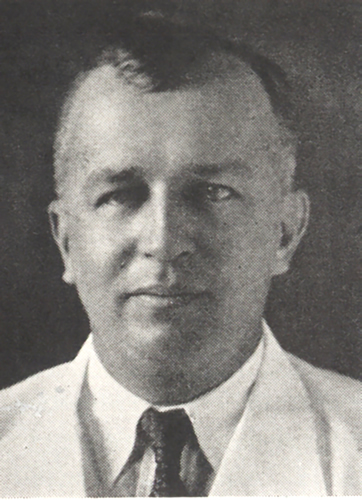

Dr. Frederick Willer Meyer – a devoted friend, a faithful servant and a Hopevale martyr. 

Dr. Frederick Willer Meyer, a medical doctor, his wife Ruth Violet Schacht Meyer, and a nurse, Jennie Claire Adams, were assigned as missionaries in the province of Capiz, specifically, to the Capiz Emmanuel Hospital before World War II broke out.

In one of Dr. Meyer’s letter to Dr. J.W. Decker of the American Baptist Foreign Missionary Society based in 152 Madison Avenue, New York, dated May 17, 1943, he described with a hopeful spirit the underlying foundation as to why they continued the healing of ministry of the Lord Jesus Christ even in the midst of war. He wrote, “Our hospital—therefore—with no equipment, hardly any medicines with its missionary residue of personnel in grass hut buildings in jungle, sends our home folks loving greetings. We carry on—because of Emmanuel—God with us.”
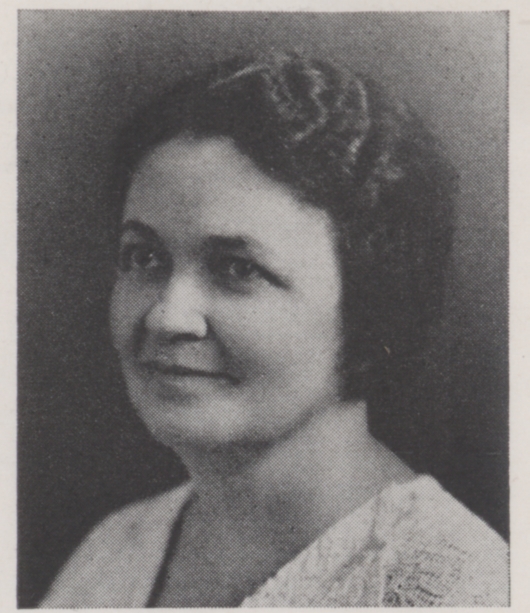

Ruth Violet Schacht Meyer, the devoted wife of Dr. Meyer.

The American Baptist missionaries who chose not to surrender during World War II fled to the mountains of Tapaz, Capiz in a place they later called Hopevale. Dr. Meyer acknowledged Dr. Francis Howard Rose’s creativity in finding a place of worship. He narrated, “Dr. Rose’s beautiful outdoor cathedral is the Sunday meeting place.” In a separate letter dated May 18, 1943, Dr. Rose wrote that it was Mrs. Ruth Violet Schacht Meyer who would always sing during the Sunday worship service, and it was Dr. Meyer who provided a folding organ for their music.

Dr. Meyer recounted that due to the scorched-earth policy of the Japanese Imperial Army, their place was burned, some buildings, as well as, sadly, also their library, were destroyed. He likewise wrote that their compound (Capiz Emmanuel Hospital and Filamer Christian Univerisity) were used by the Japanese forces as a fort. Because of this, the hospital was evacuated into the interior parts of Capiz. Despite all these, the healing ministry continued. They scattered the hospital beds to different hill clinics and Dr. Meyer and Ms. Adams would do a lot of consultations after some long hikes. Dr. Meyer reported that the “residue of Emmanuel have been of daily service to the district; medical missions can carry on even in very trying surroundings.”
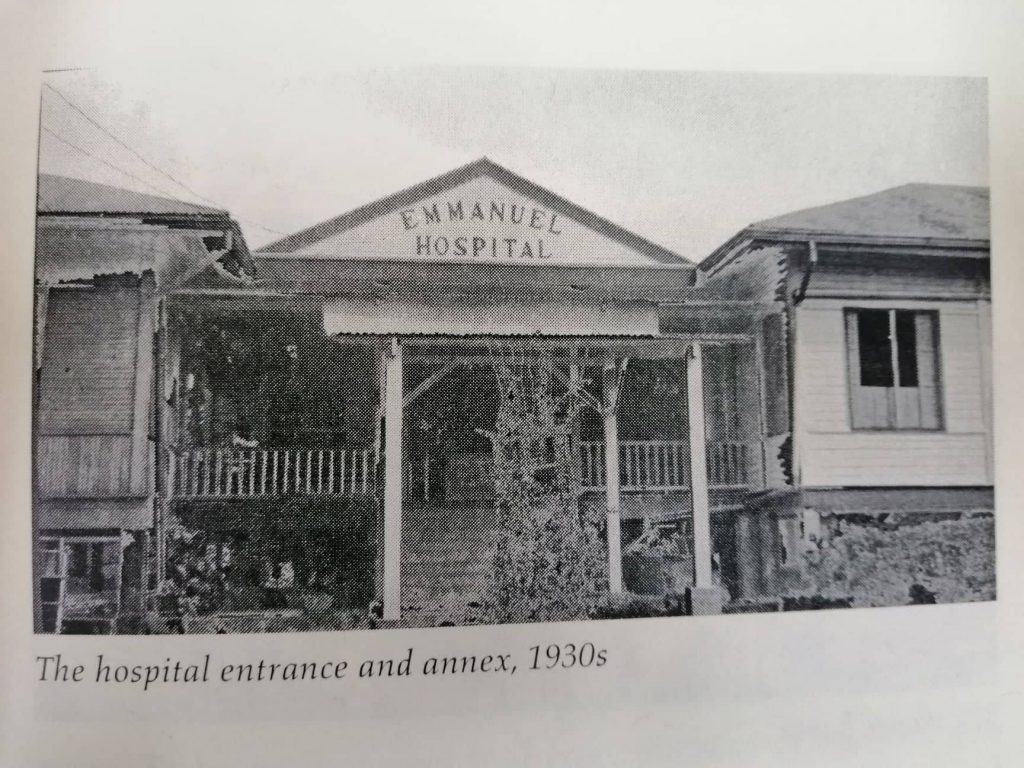

An old picture of Capiz Emmanuel Hospital.

A physician-surgeon by profession, Dr. Meyer was the Director of Capiz Emmanuel Hospital in Capiz from 1919 until 1943 with furloughs between 1924 to 1925, 1930 to 1931, and 1937 to 1938. He performed as a one-man physician-surgeon-administrator every day. In 1938, he was adopted by the Capiz Provincial Board as “a worthy son of Capiz.”   He also founded the Capiz Medical Society.

Despite of the war, the missionaries found peace and calm assurance because of their faith. Dr. Meyer described their life in Hopevale: “The forest is a wonderful residence, monkeys, gaily colored birds all around us; sympathetic mountaineers, loving barrio folks, make our lives happier… We are very poor in earthly possessions, but God inspires our neighbors to be of great help, so there has been plenty of food.”

At the end of his letter, Dr. Meyer hoped that when peace would come, he could bring the whole story to the world. He assured his son, Milton Frederick, Jr., that they are praying for him and his brothers and that the couple missed and love their children very much.

Sadly, a few months later, on December 20, 1943, the 11 American Baptist missionaries, including Dr. Meyer and his wife Ruth Violet, were martyred because of their Christian faith in Hopevale, Tapaz, Capiz.

On April 12, 2002, Capiz Governor Vicente Bermejo, posthumously gave a plaque to the Meyer family for Dr. and Mrs. Meyer’s “selfless service” to the province of Capiz.

On December 17-20, 2018, the Convention of Philippine Baptist Churches will spearhead the Hopevale Diamond Commemoration to be held in Central Philippine University, Filamer Christian University and in Hopevale, Tapaz, Capiz. If you attend, you will surely hear more stories about these American Baptist missionaries and their Filipino counterparts.
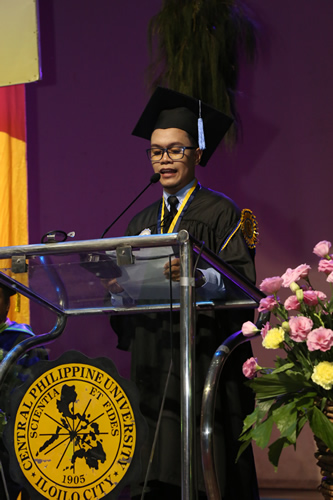
Response on behalf of the Graduates given by Bryan Paul L. Espinosa, magna cum laude, delivered during the CPU 91st Commencement Exercises of the Colleges at the Rose Memorial Auditorium on November 11, 2018


Bryan Paul L. Espinosa, magna cum laude, BSEd Major in English, encouraged his fellow graduates to excel for the Lord.

To our University President, Dr. Teodoro C. Robles, our guest speaker, Dr. Rumalie Corvera, all members of the Board of Trustees, the administrators, the deans, our professors, the staff, our parents, family, friends and most especially, my dear beautiful and handsome graduates, hello! Good afternoon! How are you?

Today is 11.11. In the field of numerology, 11.11 is an auspicious sign, a sign of enlightenment and insight, a way for the Universe to tell us that we are on the right path towards growth and development. Among the Chinese, 11.11 is that one day in a year for people who can’t find true love to celebrate being single by wallowing themselves in online shopping. But to us, midyear graduates, 11.11 means a celebration of success. Reaching this point was not easy, and I am sure that we all share common stories. We all had days when we walked like zombies towards school for lack of sleep just because we stayed up in the wee hours of the morning to comply with a requirement. We also experienced having to see our friends graduate ahead of us because we failed a subject although we tirelessly did our best. Whatever the case was, for a moment, remember what you have gone through to reach this point. Indeed, it was not easy but it was worth it.

My journey towards this point was not a walk in the park either. I had to go to school in the daytime and to avoid adding burden to my parents, I have to go to work at night as an online English teacher from 6 till around midnight. Thank God, I didn’t have 7AM classes or I’d be dead. Because of my hectic schedule, the only time I really had to study was at school. I’d go to the library or find a room in OV or NV to study during my vacant periods. I promised to do my best in my studies even if that meant being awake for 24 hours—which happened only twice. However, despite how strong my spirits always were, I could never evade exhaustion. I remember while waiting for my next class, I would go to the Half-moon field, find a bench, and ask a friend to watch over me as I nestled comfortably with my bag as my pillow.

I was also a board member of the student council in my third year, a team captain of the COED debate society for two years, and thank God, I am still alive. I was relentless and still very healthy. I had goals and I was ambitious. I worked hard and it paid off. But mind you, I didn’t accomplish what I did on my own.

You see, I have amazing, great friends who are mostly work students; they added color to my stay here in Central. I have passionate teachers who inspired, motivated, and encouraged me—the faculty of the College of Education and our dean, Prof Junsay, the faculty of the English Department, and the other departments. Outside Central, I have my ever-supportive parents, my siblings, my Uncle Leo, the Espinosa and Landar families. I also have my Chinese students who have become my friends. Definitely, I thank the heavenly Father for giving me the best opportunities and for preparing me for them by sending me these amazing people. Indeed, I didn’t reach this far on my own.

Graduates, we didn’t reach this far on our own. So, on behalf of all the graduates, dear Central Philippine University, I thank you from the bottom of our hearts. You have been our home for the past three to five years. The memories we shared will always be here in our hearts. To our parents, teachers, and friends, do know how much you all mean to us.

Dear Graduates, God sent many wondrous people who shaped us and fostered in us values and principles to live by. So, as we go on our way and dance to the hymn of life and ascend towards success, let us not forget to breathe a prayer of gratitude for those who helped us get here and there. When setbacks and failure drop by however, let us embrace them and hear their whisper. Listen to what failures have to say, and drop them to your feet as fertilizers to help your branches bear flowers and fruits. Life was never easy and it will never be, but when we plant seeds of faith and hope in our hearts, we’ll grow wings and fly. As we take flight, remember not to compare the span of your wings with others, for you will wither in vain, because there will always be someone better and lesser than yourself. Fly at your own pace and at your own time. Enjoy the view. Appreciate. Love. Live. Always affirm that as we glide through the skies, God sends the wind, both cold and warm, to prepare us for a journey farther from where we are now. We have braved many storms, but we have also witnessed many rainbows. We have been prepared for many great things like gold molded in a burning furnace into precious jewelry. Now, we emerge victorious as instruments of God’s divine will.

Dear graduates, with everything that we have gone through, and now finding ourselves here, we deserve a loud applause! Do tell yourselves and your seatmates, “You are glorious.” Remember to embrace every single person who helped you find your pedestal and who helped you stand where you now find your feet. Let us remember to keep alive and burning the spirit for learning that Central has nurtured in our hearts, and let this burning fire be like a star that reaches and guides many people. Let us fill our cup to the brim with optimism and gratitude, with love and faith in the Lord. Let us carry Central in our hearts, and wherever our wings may bring us, let us remember God.

We are here because of Him. He has always been here. Right now, He is here, celebrating and enjoying this victory with us.

Congratulations, dear Centralian graduates! Let us all spread our wings and fly!

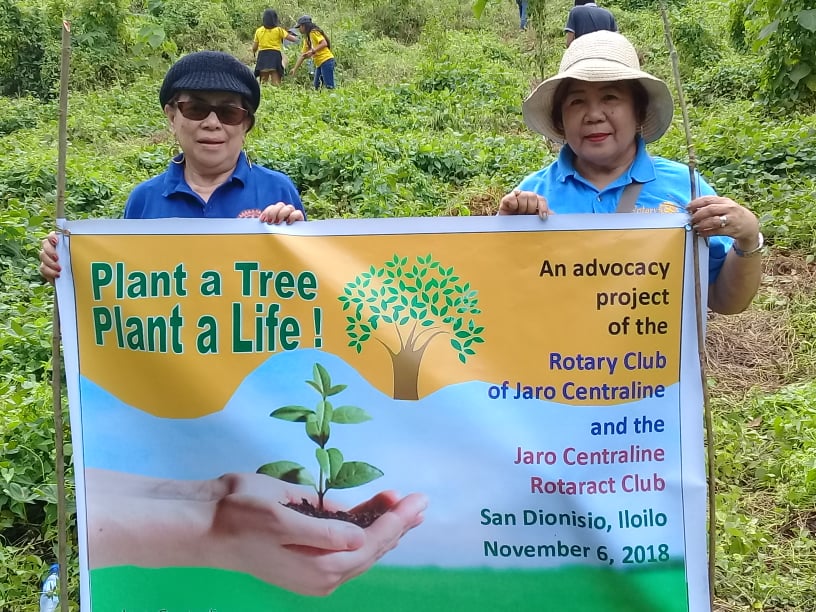
Plant a Tree, Plant a Life

By Cyrus A. Natividad


RCJC President Evelyn Rose A. Catilo (right) and RCJC Auditor Rtn Dolores Mendiola at the Tree Planting site in San Dionisio, Iloilo.

The CPU-Rotary Club of Jaro Centraline once again showed its commitment to serve. On Tuesday morning, November 6, CPU-RCJC, in partnership with the Community Environment and Natural Resources Office (CENRO-Sara Center), carried out a tree-planting activity in San Dionisio, Iloilo at Barangay Pangi. The youth organization, CPU-RCJC Rotaract, was also involved in the said activity. Seedlings were provided by the Department of Environment and Natural Resources.

The tree-planting activity is in response to the government’s reforestation program. More than 800 hectares is dedicated for the project of reforesting and generating income for several community volunteers including the Pangi Active Community Development Association (PACDA).

DENR provided seedlings to the volunteers who will receive PhP 25.00 for every tree that grows in 10 months. The CPU-Rotary Club of Jaro Centraline waived the incentive and instead asked that it be awarded to PACDA.

The successful activity was fully supported by Mr. Rene Grande Abordo, Officer in Charge of CENRO Sara Area of Operation.

CPU– RCJC President Evelyn Rose Abordo Catilo promises more such programs and projects to be pursued this year. “The CPU-RCJC will have more community service activities since the partnership of our club and Central Philippine University has benefited many communities in Iloilo,” Catilo said.

CPU-RCJC has been reaching out to recipient communities and organizations on projects such as medical and dental missions, education, and other advocacies.

The missionary zeal of Rev. Dr. Francis Howard Rose

Francis Neil G. Jalando-on


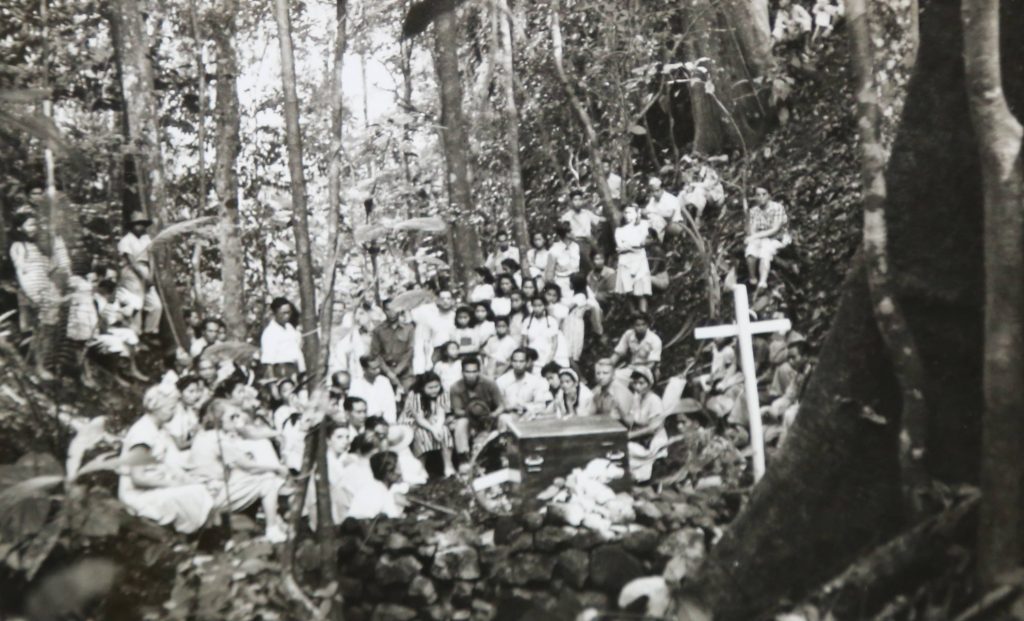
American Baptist missionaries and CPBC members visited the “Cathedral in the Glen” after World War II.

In a letter dated May 18, 1943, marked “Strictly Confidential,” addressed to a certain “Dr. Decker and all at the Rooms” of the American Baptist Foreign Missionary Society, Rev. Dr. Francis Howard Rose described their situation in the mountains of Tapaz, Capiz after 13 months.

Dr. Rose, a gifted artist, described the setting of the “Cathedral Glen Community Church”—a label that he himself made. He wrote, “Near our camp there is a beautiful deep dry gorge with giant trees growing in it. Here during the first weeks of our pilgrimage I built seats, altar, pulpit and lectern, all of wild or uncut stones and small rocks and we have conducted worship in this place every Sunday…” Furthermore, he narrated, “Several missionaries take their turns at conducting worship and the doctor’s wife sings solos frequently. A folding organ is provided by the evangelistic missionary from the Doctor’s compound.”

As a pastor, Dr. Rose continued his pastoral ministry in “Hopevale.” He recounted, “One Easter Sunday, I had the joy of baptising a thirteen year old boy, son of one miner couple here, in a beautiful shady pool in a little mountain river that flows by not far from our camp. About a hundred attended this Easter service.” He even visited some nearby churches: “Church work is going on in town and country with remarkable fortitude on the part of pastors and congregations. Last Sunday I preached at a country church about eight miles from the nearest enemy outpost and a half mile from the provincial highway; eighty people present, mostly women and children, however.”


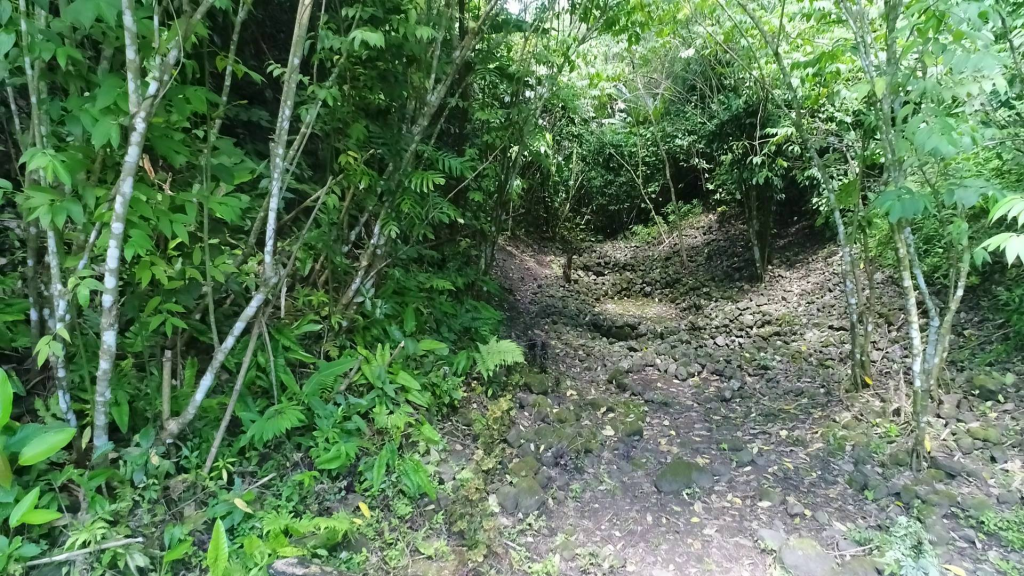
This pathway and lush forest stood witness to the testimony and faith of the Hopevale martyrs.

As the American Baptist missionaries were with fellow evacuees, Dr. Rose praised the generosity of the Filipinos who were with them. He wrote, “They have proven to be very helpful to us and all are of a disposition pleasing to live with even in such trying circumstances. Some of them have lent us money liberally to help us along until we are able to draw our salary again… The national protestant Christians near here have been extremely helpful in getting supplies for us… Some have risked their lives for us, not once nor twice, but some several times.” He described what they were eating: “We have always had plenty of food here; some canned goods, but mostly native things, with plenty of good fruits in season, pork and carabao meat occasionally, as with sweet potatoes and sweet corn.”

The letter signed by Francis and Gertrude Rose ended with these words, “God be praised it so well with us to date. Love to all.”

Seven months after the letter was sent to New York, USA, the 11 American Baptist missionaries, including Dr. Rose and his wife Gertrude, were martyred because of their Christian faith in Hopevale, Tapaz, Capiz.

On December 17-20, 2018, the Convention of Philippine Baptist Churches will spearhead the Hopevale Diamond Commemoration to be held in Central Philippine University, Filamer Christian University and in Hopevale, Tapaz, Capiz. If you will attend, you will surely hear more stories about these American Baptist missionaries and their Filipino counterparts.
The Remedy of Trust

By Keziah G. Huelar


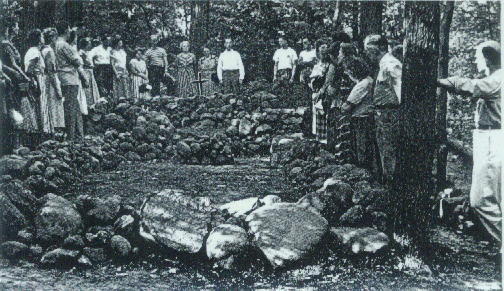
After World War II, CPBC members started a tradition of pilgrimage to the Cathedral in the Glen also known as the Hopevale Memorial.

At some point of our lives we have considered giving up. Our soul seeks rests, our hearts wishes to retreat into solitude. There are things in this world that may be too much for us to bear—the pressures of life consume us all. Yet despite these moments of denouement, we persevere not only as a necessity but as a response to the choices we make.

Such a choice has been testified through the life of the Hopevale martyrs. Up to the end of their lives, they chose to persevere and trust in the Lord—11 men and women of faith—whose lives we now emulate as we reflect upon pursuing a life of faith with fervor.

In one of her poems entitled “I am weary of war”, Jennie C. Adams, one of the martyrs, talks about a longing for rest and ease;

I am weary of war and its worries,
The life in a forest wild
The haunts of a lovely hermit,
A captive too long exiled
Ever ready to flee still further
When the warning cry is heard,
Whether that cry be official
Or proves but a rumored sword
The vigilance ever required
When enemy troops grow bold,
Or when thieves alone molesting,
Or but termites, mildew and mold.

I am weary of war and hatreds,
When a friend may become a foe;
A nation, a neighbor or brother
Into a traitor may grow.
Need presses hard upon people
One grasps from another’s pain
Out of some poor man’s misery
A neighbor grows greedy for gain.
One clamors for share and profit
A place, a position or fame,
One lives or dies a hero,
His brother lives in shame.

I am weary of war and its sufferings,
The nameless dreads and fears,
The needless wounds and heartaches
The women’s bitter tears
The children in rags growing hungry,
Hunger on every hand,
No schools for their idle hours,
With pestilence stalking the land.

I am weary of war and destruction,
A land once so verdant and fair,
Busy and prosperous and peaceful
Is scorned and seared and bare,
What wanton waste of nations
Whose country with beauty was filled,
The gems of civilized nations
That years have required to build.
The treasures of homes and nations,
That ages so dearly have brought
By ruthless war’s destruction,
In a moment is put to naught

How hard it must have been for the Hopevale martyrs to retreat to the mountains, away from the comforts of civilization. They found themselves in the midst of primitive living where they made an altar and a pulpit from rocks and wood at hand.

But oh, how hopeful they were! In the heart of the Japanese-American War, we had missionaries gathering together to worship God in the midst of all the doubt and uncertainty. On Easter Sunday of 1943, it is said that 100 worshipers, both Americans and Filipinos, were in attendance to glorify God. Several missionaries took turns in conducting the worship services.

How beautiful it is to worship God in the midst of trial—like Paul and Silas when they prayed and sang songs of praise in prison, when Stephen exclaimed, “I see heaven open and the Son of Man standing at the right side of God!” right before those who were about to stone him, and when the Hopevale martyrs asked for an hour to pray and to sing hymns before they were led to the mountain top and killed.

Whenever life drags you down, the remedy is to praise God, to trust in His promises. At times, the greatest blessing is not the fulfillment of the promise but the ability to believe and to hope that what God has spoken will come to pass. As what 2 Corinthians 1:20 says, “For all the promises of God in Him are Yes, and in Him Amen, to the glory of God through us.”

Adams, in her poem “Let me live bravely,” published in the 1946 Centralite, encourages us to learn to trust God before, during, and after life’s troubles.

“Let me serve faithfully;
Content with work to do, Whatsoever life may bring,
I’m serving others well, Thus do I serve my King.
May I not weary grow, When tasks seem burdensome,
Nor turn aside distraught, Before life’s work is done.
As others served, proved true, Let me be faithful too.”

In focus at Looking Forward: Rev. Joniel Howard H. Gico

By Cyrus A. Natividad


CPU Vice President for Student Affairs (VPSA), Rev. Joniel Howard H. Gico talks about his years of service in CPU.

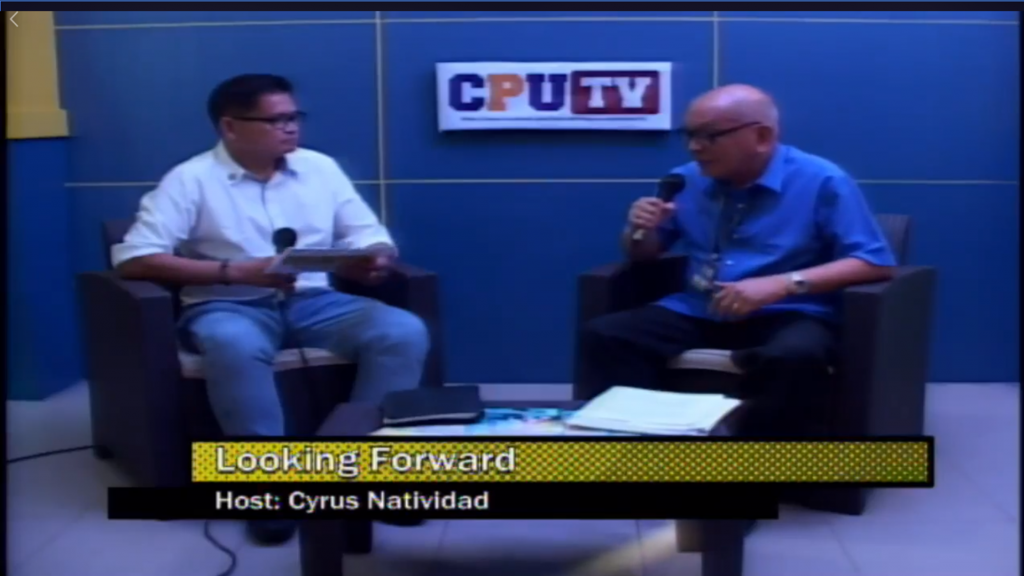
CPU Vice President for Student Affairs (VPSA), Rev. Joniel Howard H. Gico, was a guest in Looking Forward, a program on CPUTV Facebook Channel, last Friday October19. The 30-minute interview included issues on the functions of the VPSA office, its achievements and programs for the students and the student organizations.

Gico’s position as VP for Administration before his appointment as VP for Student Affairs effectively contributed to his efficient management of the affairs of students inside the campus, which include discipline, strategies, and parameters on student organizations and fraternities (qualifications and restrictions on student groups ) before they are certified as members of a standard student organization by the VPSA Office.

Gico was upbeat on the development and progress of students in the University, and that of the student organizations. He also talked on the achievements of the current CPU student republic (CPUR) to which he gave credit for the many achievements it has done for the students and the campus.

In support of CPUR, the VPSA provides certain policies that enable CPUR officials to make programs for the benefit of the campus and student organizations. The VPSA deems it important to support any and all qualified student organizations in relation to its programs and projects in the University.

Reverend Gico is a graduate of Mechanical Engineering from Central Philippine University in 1976 and has worked with La Carlota Sugar Central and San Miguel Corporation Packaging Division as shift engineer. He has been the president of the Convention Baptist Bible College – before coming back to serve Central Philippine University.

He is a continuing student taking up Doctor of Management with focus in Development Management at CPU. He is a graduate of Master of Theology from the Southeast Asia Graduate School of Theology (SEAGST) and Master of Divinity Major in Pastoral Ministry, College of Theology, Central Philippine University.

He is currently the Chairman of Iloilo Mission Hospital Construction Committee, a member of Iloilo Mission Hospital Corporation and Central Philippine University Corporation, among others.

The Cathedral in the Glen: What does it look like?

By Francis Neil G. Jalando-on


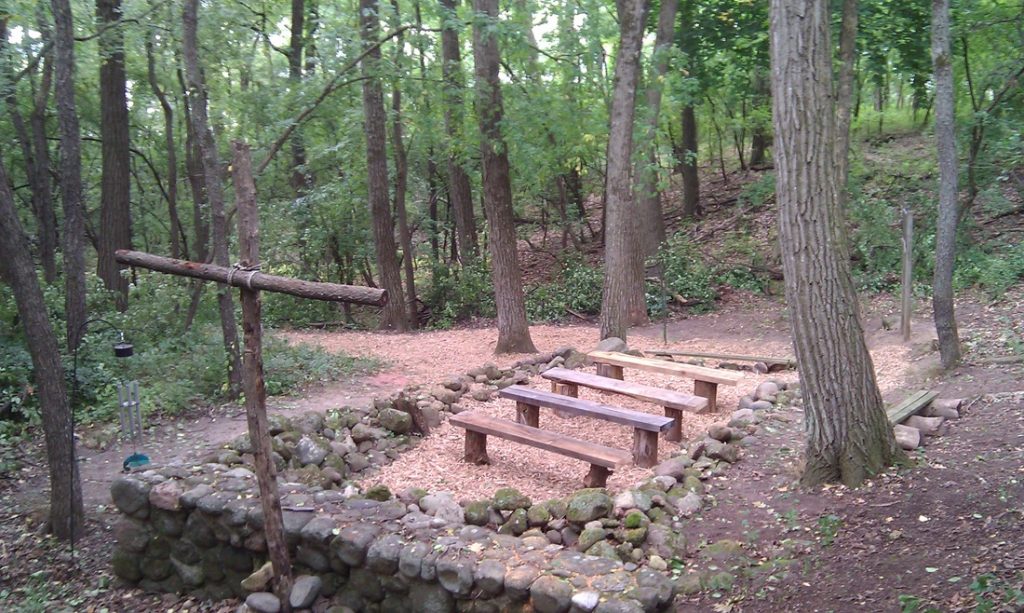
A replica of the Cathedral in the Glen in Greenlake Conference Center in Wisconsin.

Situated in Central Philippine University, between the Henry Luce III Library and the Rose Memorial Auditorium, is the Hopevale Memorial. There stands a creative rendition of the Cathedral in the Glen, an open-air church designed and built by Dr. Francis Howard Rose in Tapaz, Capiz. A similar replica of the Cathedral in the Glen can be found in Green Lake Conference Center of the American Baptists Churches in Greenlake, Wisconsin.

Can you picture the Cathedral in the Glen or the Hopevale Memorial in your mind? What does it look like?

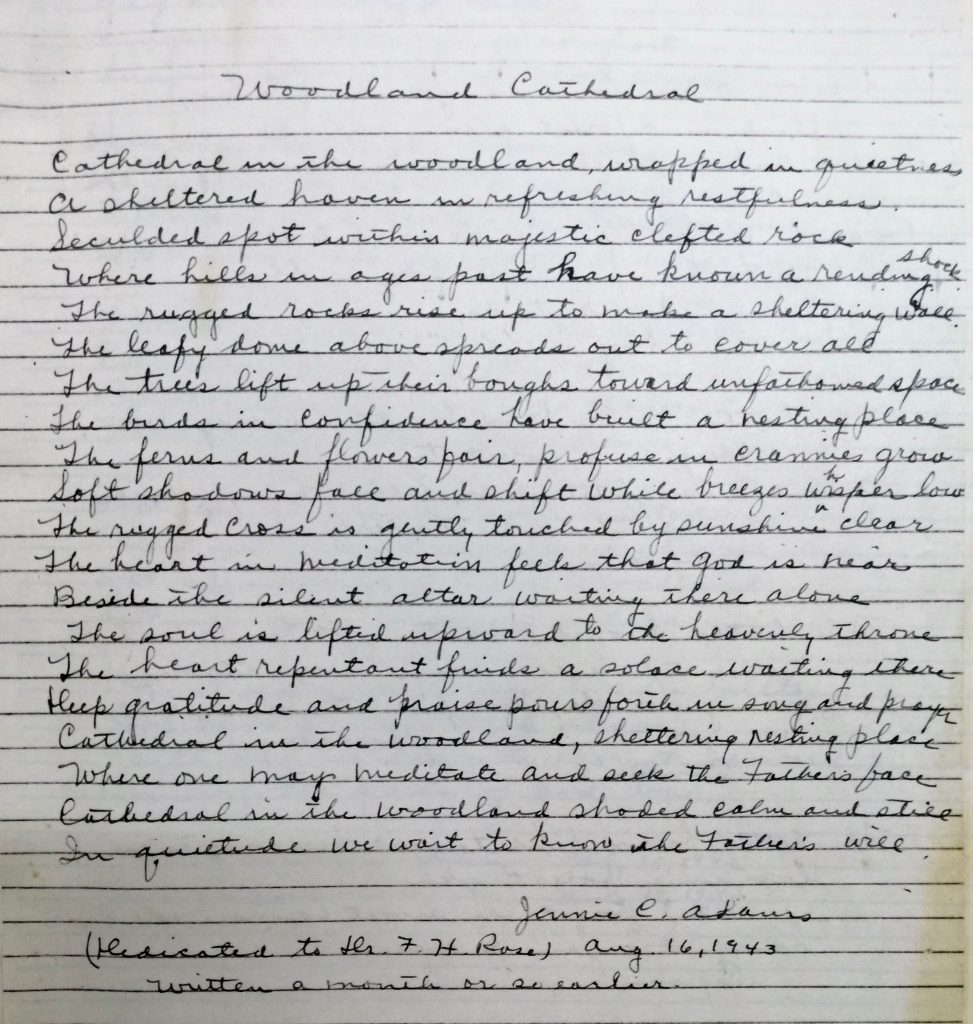
Four months before the 11 American Baptist missionaries were martyred because of their Christian faith in Tapaz, Capiz on August 16, 1943, Jeannie Claire Adams, a missionary nurse assigned in Capiz Emmanuel Hospital, described the Cathedral in the Glen through a poem she dedicated to Dr. Francis Howard Rose entitled “Woodland Cathedral.”


The original poem entitled Woodland Cathedral handrwritten by Jennie Claire Adams in 1943.

Here is the poem:

“Cathedral in the woodland wrapped in quietness

A sheltered haven in refreshing restfulness

Secluded spot within majestic clefted rock

Where hills in ages past have known a rending shock

The rugged rocks rise up to make a sheltering wall

The leafy dome above spreads out to cover all

The trees lift up their boughs toward unfathomed space

The birds in confidence have built a nesting place

The ferns and flowers fair profuse in erannies grow

Soft shadows fall and shift while breezes whisper low

The rugged cross is gently touched by sunshine clear

The heart in meditation feels that God is near

Beside the silent altar waiting there alone

The soul is lifted upward to the heavenly throne

The heart repentant finds a solace waiting there

Deep gratitude and praise pours forth in song and prayer

Cathedral in the woodland, sheltering resting place

Where one may meditate and seek the Father’s face

Cathedral in the woodland shaded calm and still

In quietude we wait to know the Father’s will.”

Louise Reid Spencer also described the Cathedral in the Glen in her book Guerrilla Wife. She and her husband, Cyril L. Spencer, a mining engineer, took refuge with the American Baptist missionaries in Hopevale. Unlike the 11 martyrs, they were able to escape and were subsequently rescued by the Allied Forces.

Here is what Louise Reid Spencer wrote in her book:

“The HOPEVALE CATHEDRAL was a gem of outdoor architecture… Dr. Rose built the cathedral himself every stone of it. It was open to the sky, and, in its contours, formed by nature herself. The gulley where we had first taken refuge was transformed, by the loving labor of Dr. Rose, into a vision of beauty and inspiration. Descending from the caingin down the slope to the level clearing between the two walls of rock. One entered the cathedral back the altar and walked the length of the church to be seated. Here, at the back, was a stone bench where about six people could sit. Straight up the center of the church from that bench ran the aisle, a stone walk wide enough for two persons to go abreast. It led to a small rectangular block of stone, where each Sunday Clifford built a fire. A few feet beyond this firebox there were three stone steps leading up to the stone altar. About three feet before the altar, one on each side, were two oval stone reading desks. Standing straight on the center of the altar was a rugged wooden cross.

At each side of the church was a stone bench where twelve people can sit. There were [sic] a hard-packed dirt terrace bordered with stone which ran in front of all three benches, the small one at the back and the two at the sides. This terrace spread out in a fan shape at the front of the church, and the organ could be placed on either side. The organ lofts were planted with wild forest bloom, so that the organist sat in a living bower of color. At the base of the altar and the reading desks Dr. Rose had also planted shrubs.

The floral decorations for the top of the altar were arranged each Sunday by Mrs. Covell, who had studied the art of flower arrangement when she lived in Japan.  It seemed ironic to me that while we hid from our brutal enemy, one of his ancient arts contributed to the decoration of our House of God.

Dr. Rose had spent months on this cathedral, his only tools his hands, a small shovel, and a chisel. He had created something so beautiful that we caught our breath when we came to it.  But he was never finished with the work of building it. He added and perfected its details constantly. The maintenance alone was quite care [sic], for there were always fallen leaves to be brushed away, and rocks and stones that crashed down from the precipitous walls on either side to be cleared and their damage repaired.

I went often to cathedral and sat there quietly for a while, watching the trees above wave gently in the breeze, watching the small, agile monkeys, high up, swinging in the vines that twined among the trees. It seemed an entirely different place the gulley we had come to as a hide-out on the 18th of April 1942.  The transformation was complete.  It truly seemed the house of God, and from it we drew confidence and faith.”

On December 17-20, 2018, the Convention of Philippine Baptist Churches will spearhead the Hopevale Diamond Commemoration to be held in Central Philippine University, Filamer Christian University and in Hopevale, Tapaz, Capiz.

If you wish to attend, you will surely see the area where the Cathedral in the Glen was constructed in Hopevale, and also the replica in Central Philippine University.

The United Nations celebrations: What it is to us

Insight
by Cyrus A. Natividad


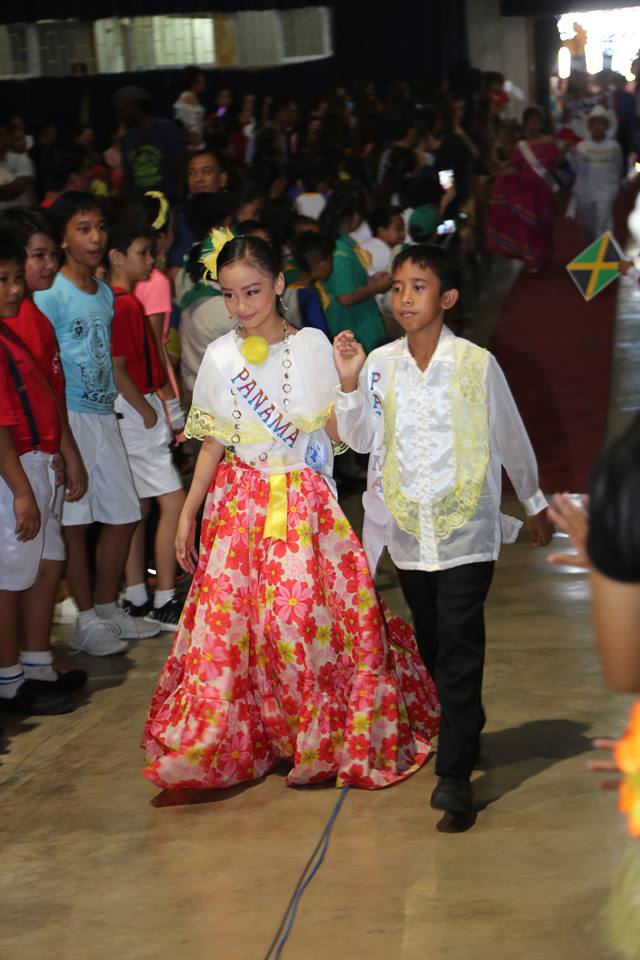
CPU’s United Nations Celebration highlights the value of respect and appreciation of all cultures.

Before we had the parade of nations—the parade of costumes and international flags to celebrate the United Nations—there was the League of Nations. The League of Nations differed from the United Nations in that the former was consisted of European countries. Due to its inefficiency, most of the small member nations pulled out of the organization, which was formed after Word War I and whose main objective was only to prevent war.

On October 24, 1945, in San Francisco California, the United Nations organization was founded. Its aim, among others, is to prevent another international conflict after World War II.

One of the aims of the United Nations is the United Nation’s Development Plan (UNDP), which focuses on issues relating to poverty. UNDP understand poverty as “not having education.” As of late, the UN reports that about 1.3 billion all over the world are affected by multi- dimensional poverty, which includes education. According to the report, half of them are kids or teenagers.

This understanding of poverty is one of the reasons why we celebrate the United Nations with the representations of colorful costumes and flags of different nations. Through these symbols, we wish to espouse solidarity for world peace and eradication of ignorance.

No only these celebrations but through the University’s overall mission and vision, CPU wishes to take part in providing workers and citizens who are educated and contribute to the development of the world and of humanity.

Re-telling Values: The Story of Tatay Cris Cyril Villanueva Balladares

by Keziah G. Huelar


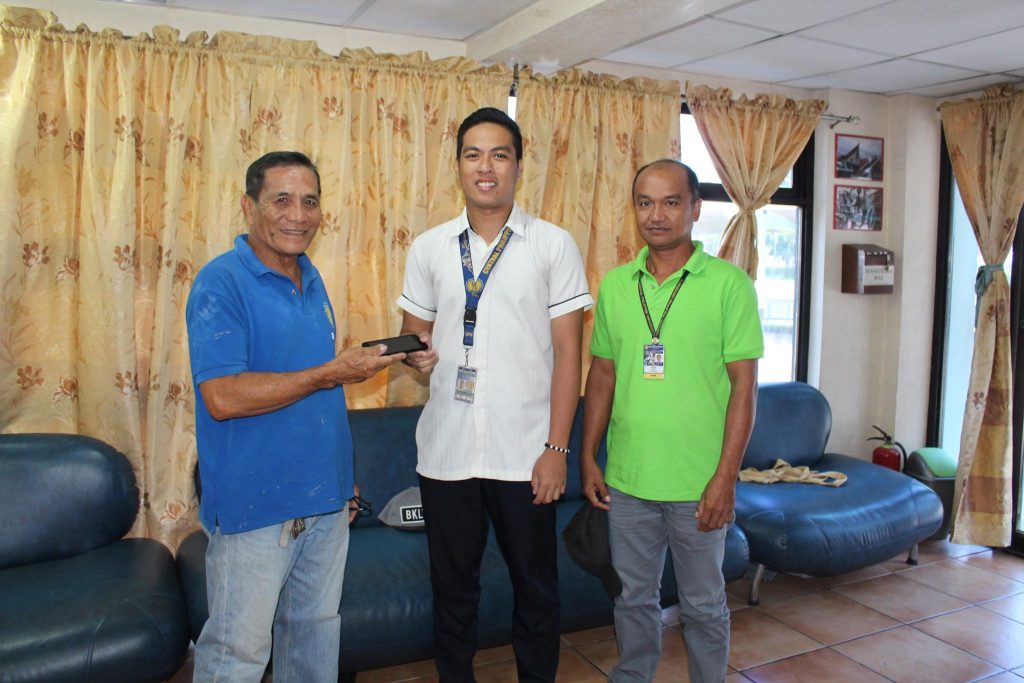
The life of Tatay Cyril reminds us that beyond success, a man of good character is more worthy of praise. In Photo: Tatay Cyril together with James Estinico, Head, Grounds Department, returning the lost cell phone to its owner, Leo Torres, a CPU BS BABM student.

Despite being 64, the only crease one can see in Tatay Cyril’s face is a friendly smile, greeting teachers and students in the campus. One could always see him cleaning the College of Engineering Building, even the Big Field. Simple these tasks of cleaning the school campus may be, but they have contributed to CPU being named as one of the most beautiful campuses in the country by www.buzzfeed.com in 2015.

Tatay Cryil started serving Central Philippine University in 1985 as one of its grounds personnel. For 33 years, Central Philippine University became his second home. Here, he labored for the dreams for his children and for his love for Christ, believing that all things work together for good to those who love God and to those who work according to his purpose.

“Una ko di nga ubra sa CPU pamanday, ilis sang mga sin sang atop, pang- lawn mower,” Tatay Cyril shares. According to him, he chose to work at CPU because the University was known to be a good employer: “Ang mga opisyales sa CPU mahapos isturyahon. Gapasalamat guid ko okay anom ko ka bata diri nag-graduate sa CPU. Biskan ang apo ko gani diri na naga-eskwela.”

As part of the ground personnel, he has seen how students would be negligent in throwing their garbage: “Hambal ko gani sa mga upod ko dapat malipay kita kay tungod gapang-haboy ang mga estudyante. Amo na nga may ubra kita. Pero dapat man nga maging responsabli kita sa kung ano nahaboy ta.”

Of his six children, three graduated from the College of Hospitality Management, two from the College of Business of Management, and one from the College of Education. Tatay Cyril shares that he wanted his children to study in CPU because of the high standard of education and the free-tuition program CPU has allotted for its faculty and staff.

After his wife died in 2001, Tatay Cyril raised his children alone: “Sang 2001, nabungguan sang jeep akon asawa. Dala niya to ang amon agot sang gin-bongguan siya, pero nabuhi ya ang amon agot kay gin-pahigad siya sang asawa ko.”

Tatay Cyril met his wife in Iloilo in the 80s. She was working as a manicurist when they fell in-love: “Ga-manicure siya sa isa aka parlor. Suki niya na day Ma’am Libo-on kag Ma’am Padernilla.”

He never married again, sharing that after his wife died, he decided to focus all his time and effort to raise their children: “Siguro kung nang-asawa ko liwat, wala ko guid napatapos ang akon mga kabataan.”

When asked how he managed to have the strength to persevere despite the many challenges he faced in life, Tatay Cyril shares that praying and reading the Bible has been a source of encouragement and faith: “Ga-pangamuyo ko sa Diyos tapos gabasa Bibliya. Kag dapat indi mo lang pag-basahon. Kilanlan ubrahon mo man kung ano ang naka-butang. ”

In the first week of October 2018, Tatay Cyril returned a cell phone left at the SMILE Hill on the Half-Moon Drive. After getting the said phone, he gave it to the office of Rev. Francis Neil G. Jalando-on, Director of the CPU Communications Office and his former chaplain in the Grounds Department: “Pag-kita ko sa cell phone, basa siya, tapos low-battery ti gin-charge ko anay. Tapos gin-hatag ko sa Information Office sa kay Pastor Jalando-on para mabutang sa Link kag makita kung sin-o ang tag-iya.”

Tatay Cyril shares that it is common to find lost things when cleaning the campus. It has been a protocol in their office to post a lost & found announcement at their office as a commitment to be honest in all their affairs: “Halin sang una, kapin pa kung may event, may kadula gid kag gaka-bilin nga mga gamit. Ga-butang na kami announcement sa office kung may makita kami tapos gina-hatag sa Information Center.”

On October 29, Tatay Cyril will be turning 65. As for his birthday wish, he prays for good health and success for his children. Retiring next year, he hopes to study automotive through a TESDA program and to see his four grandchildren grow in faith and prayer.

CPU Clinical Laboratory: Serving the University, helping the community

by Cyrus A. Natividad


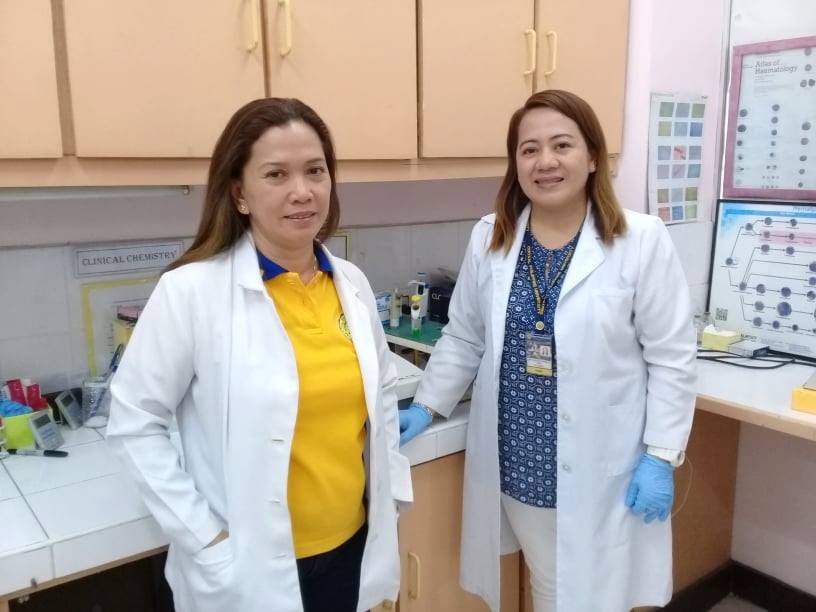
Clinical Laboratory Coordinator Mrs. Grecilda Cabral Lee (Left) and Staff Medtech Ma. Hazel Filipinas G. Villareal (Right).

The CPU Clinical Laboratory is under the direction of the clinical pathologist, Dr. Mariam Margarita Lena, who administers the day-to-day operation of the laboratory. Dr. Lena is also responsible for the in-service training of the laboratory personnel and screening for employment of qualified personnel. Dr. Lena establishes quality control and assurance procedures in order to maintain excellent service.

On the other hand, the laboratory coordinator is Mrs. Grecilda Cabral Lee, a full time senior medical technologist. Mrs. Lee’s presence while lab tests are being performed is a must although she is also readily available for personal or telephone consultations even after office hours. Moreover, staff medical technologist, Mrs. Ma. Hazel Filipinas G. Villareal, is the one that refers cases that arises in the clinical laboratory to the pathologist.

The work student assistant, also known as laboratory aides, perform several tasks needed in the laboratory, such as receiving laboratory requests and specimens, maintaining cleanliness of the laboratory, washing glassware and other instruments used in the laboratory tests, typing and recording of laboratory results and performing other  the medical technologist and pathologist.

The CPU Clinical Laboratory serves the needs of the University while fulfilling the University’s social responsibility towards the surrounding communities.